GP1-L12
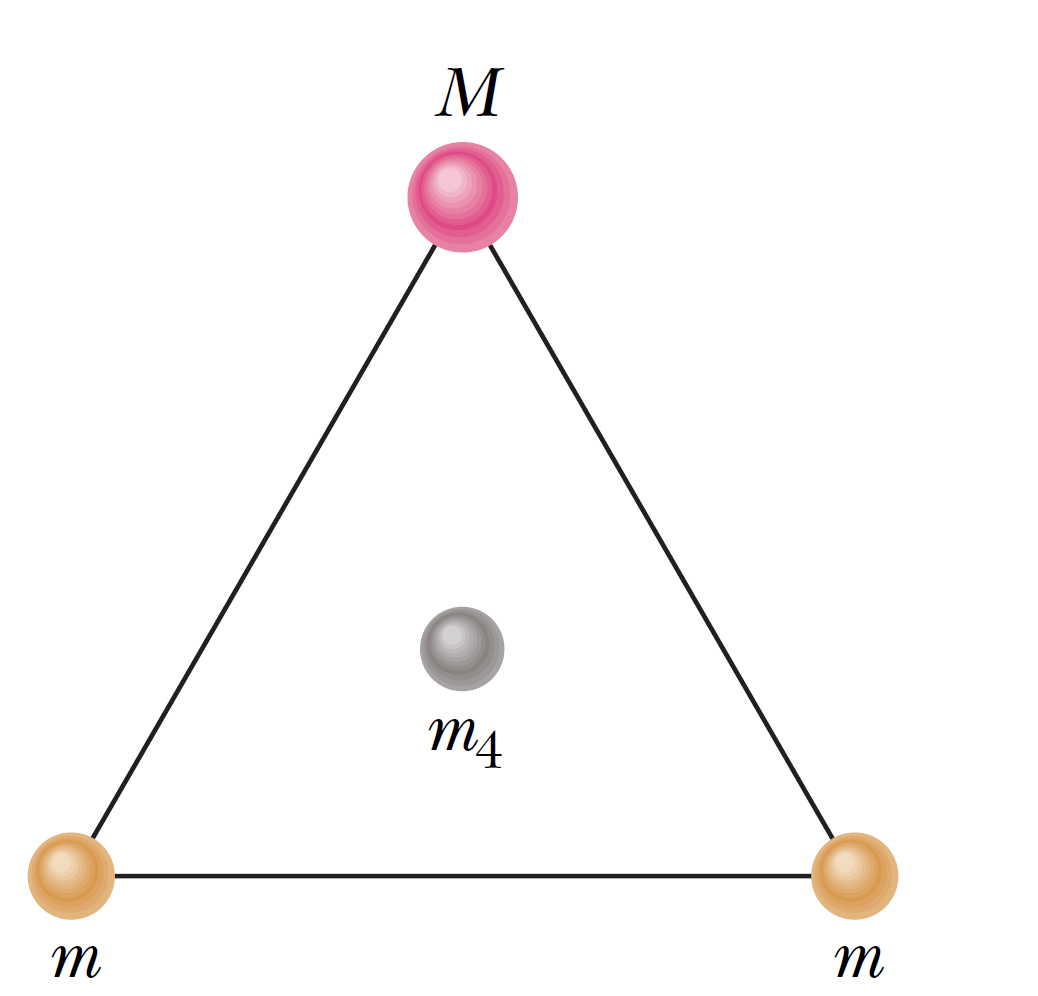 As seen in the figure, two spheres of mass m and a third sphere of mass M form an equilateral triangle, and a fourth sphere of mass m4 is at the center of the triangle. The net gravitational force on that central sphere from the three other spheres is zero. (a) What is M in terms of m? (b) If we double the value of m4, what then is the magnitude of the net gravitational force on the central sphere?
 如圖所示,質量為m的兩個球體和質量為M的第三球體形成等邊三角形,質量為\(m_4\)的第四球體在三角形的中心。來自其他三個球對中心球的淨重力為零。 (q)M=____ m ? (b)如果將\(m_4\)的值加倍,那麼中心球上的淨重力的大小是多少? (02小題)
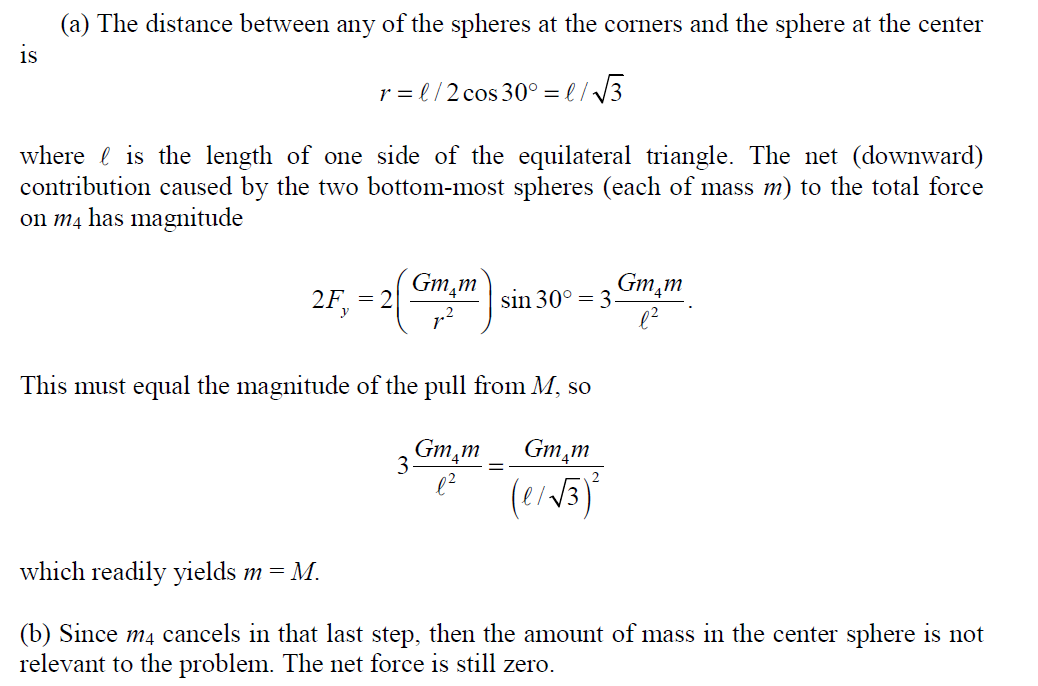
(a)M=___ m
01: ANS:=1.0
(b)F=____
02: ANS:=0
Solution:
(a)如果一個物體在地球表面的重量為100 N,它在月球表面上重量將是? (b)如果同一物體受地球的重力與在月球的重量相同,那麼該物體必須距地球中心多少個地球半徑? (02小題)
(a)W=____ N
03: ANS:=17
(b)how many radii? r= _____ \(R_E\)
04: ANS:=2.4
Solution:

從宇宙大爆炸的開始遺留下來的,微小的黑洞可能仍然在宇宙中徘徊。 如果一個質量為\(1×10^{11}\) kg(半徑僅為\(1×10^ {-16}\) m的黑洞到達地球,它的引力在距您的頭部多少距離的地方拉你的力量與地球的重力相等?將你的身體視為一個質點。 (01小題)
mini black hole's distance from your head=____ m
05: ANS:=0.8
Solution:

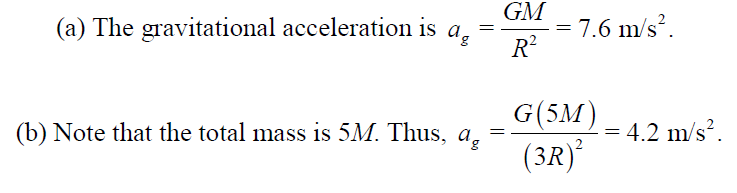
某個行星的一個模型具有一個半徑R和質量M的核,並被一個內部半徑R,外部半徑2R和質量4M的外殼包圍。 如果\(M = 4.1 \times 10^{24}\) kg和\(R = 6.0 \times 10^6 \) m,則粒子在距離行星中心(a)R和(b)3R點處的重力加速度是多少? (02小題)
(a)\(a_g\)=____ m/s2
06: ANS:=7.6
(b)\(a_g\)=____ m/s2
07: ANS:=4.2
Solution:
據信某些中子星(極緻密星)的自轉速度約為1轉/秒。 如果此類星體的半徑為20 km,那麼它的最小質量必須是多少,以便在快速旋轉過程中其表面上的物質可停留在表位? (01小題)
\(M_{min}\)=____ kg
08: ANS:=4.7E24
Solution:

nprob= 6 6
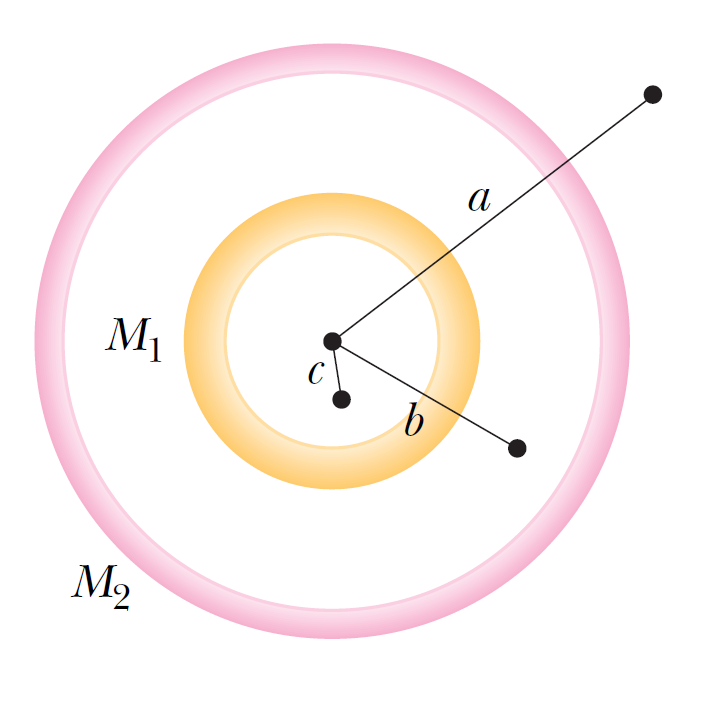 Two concentric spherical shells with uniformly distributed masses \(M_1\)=M_1 and \(M_2\)=M_2 are situated as shown in the figure. Find the magnitude of the net gravitational force on a particle of mass \(m\), due to the shells, when the particle is located at radial distance (a) a, (b) b, and (c) c.
 如圖所示,放置了兩個質量均勻分佈的同心球殼\(M_1 \)= M_1和\(M_2 \)= M_2。 當質點位於徑向距離(a)a,(b)b和(c)c時,由於殼的作用,求出質量為\(m \)的質點上的淨重力的大小。 (03小題)
(a)\(r=a, F_g=\)_______ [M_1,M_2,m,a,b,c,G]
09: ANS:=(G*(M_1+M_2)*m)/a**2
(a)\(r=b, F_g=\)_______ [M_1,M_2,m,a,b,c,G]
10: ANS:=(G*M_1*m)/b**2
(a)\(r=c, F_g=\)_______ [M_1,M_2,m,a,b,c,G]
11: ANS:=0
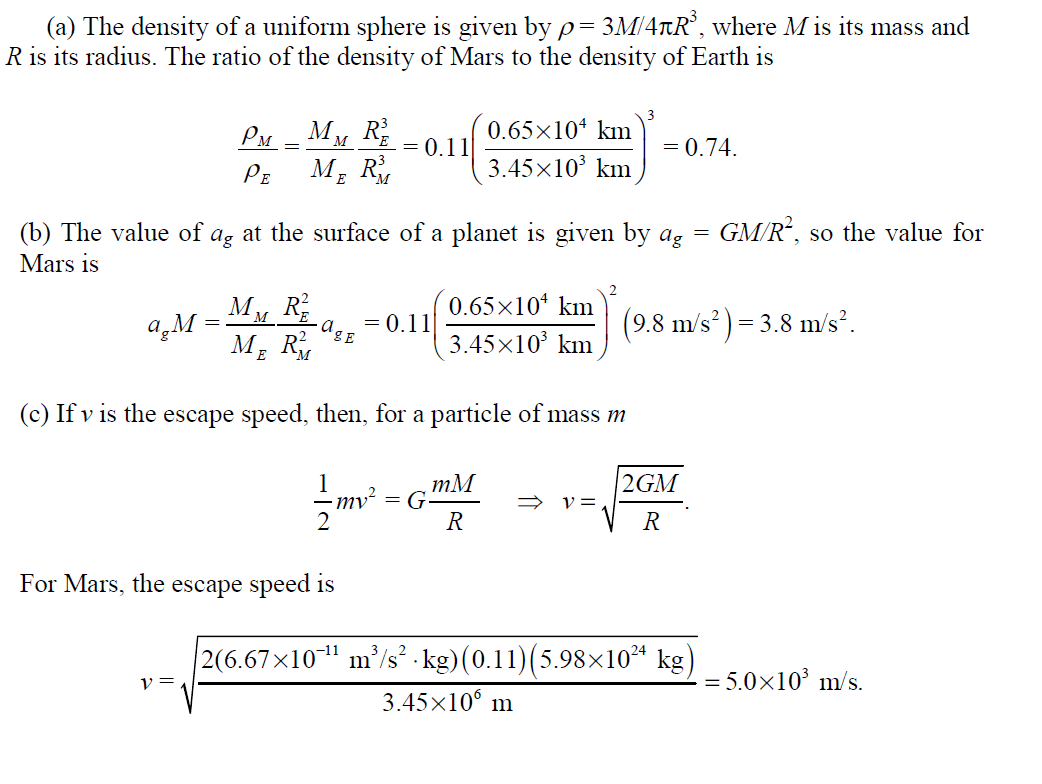
火星和地球的平均直徑分別為\(6.9 \times 10^3\) km和\(1.3 \times 10^4 \) km。 火星的質量是地球質量的0.11倍。 (a)火星與地球的平均密度(單位體積質量)之比是多少? (b)火星上的重力加速度值是多少? (c)火星上的逃逸速度是多少? (03小題)
(a)\(\dfrac{\rho_{Mars}}{\rho_{Earth}}\)=_____
12: ANS:=0.74
(b)\(g_{Mars}\)=_____ m/s2
13: ANS:=3.8
(c)\(v_{\text{esc,Mars}}\)=_____ m/s
14: ANS:=5000
Solution:
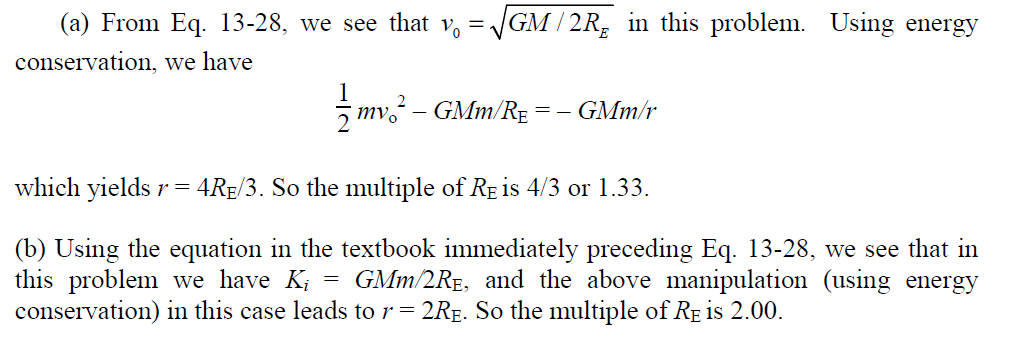
一拋體直接從地球表面射出。忽略地球的自轉。如果(a)初始速度是從地球脫離速度的0.5,則拋體到達的徑向距離是地球半徑\(R_E\)的倍數。(b)初始動能是脫離地球所需動能的0.5,則拋體到達的徑向距離是地球半徑\(R_E\)的倍數。 (02小題)
(a)the distance it reaches, r=____ \(R_E\)
15: ANS:=1.333
(b)the distance it reaches, r=____ \(R_E\)
16: ANS:=2
Solution:
火星衛星火衛一在半徑為\(9.4 \times 10^6\) m的近似圓形軌道中移動,週期為7 h 39 min。 根據這些信息計算火星的質量。 (01小題)
mass of Mars=______ kg
17: ANS:=6.5E23
Solution:
太陽距銀河系中心\(2.2 \times 10^{20}\) m,每\(2.5 \times 10^8\)年圍繞該中心旋轉一次。 假設銀河系中的每顆恆星的質量等於太陽的質量\(2.0 \times 10^{30}\) kg,這些恆星均勻分佈在銀河系中心周圍的一個球體中,並且太陽位於該恆星球體的邊緣,請估計銀河系中的恆星數。 (01小題)
the number of stars in the Galaxy=______________
18: ANS:=5.1E10