 愛因斯坦的狹義相對論如何拯救磁鐵理論(Dr. Don Lincoln, Fermi Lab)
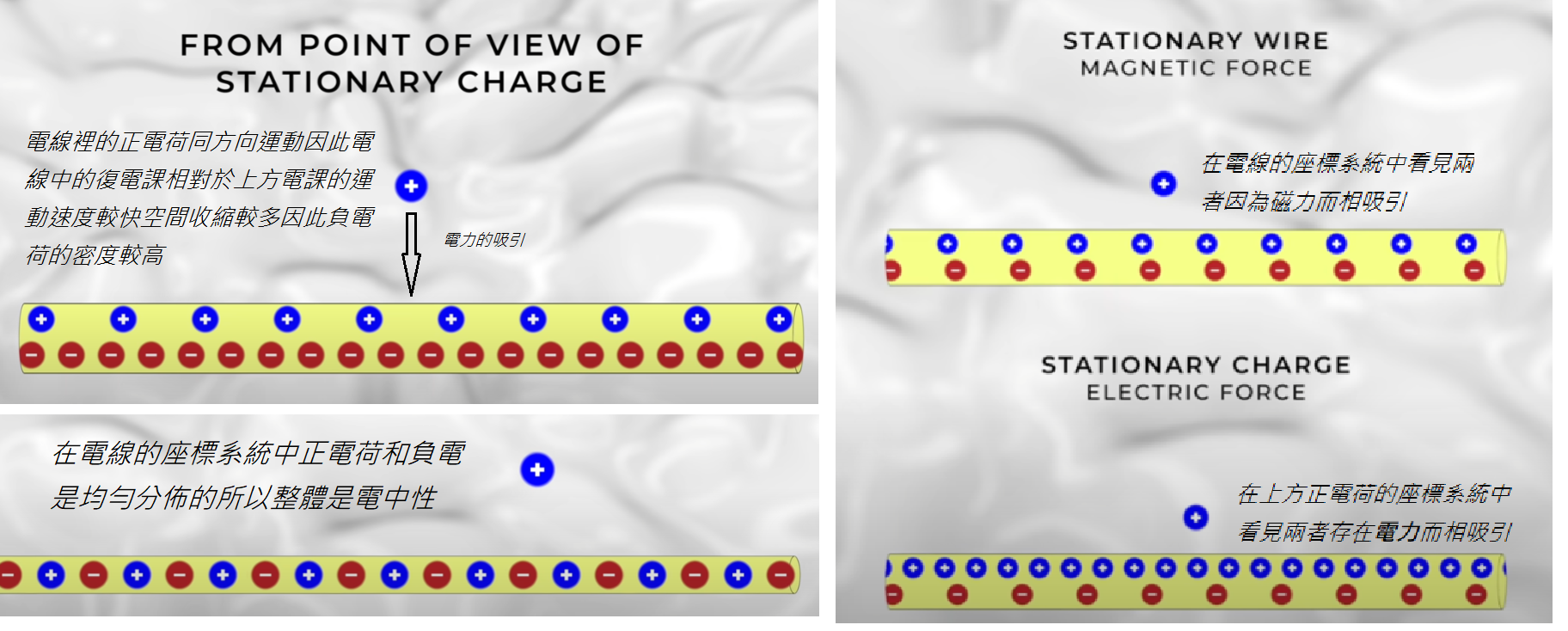
單憑馬克斯威爾方程式沒有辦法解釋為什麼磁鐵有磁性磁鐵看起來非常神秘。 它們的行為可以用Maxwell方程組來解釋。 然而,不小心的話你很容易讓自己相信麥克斯韋方程組證明磁鐵不可能發揮磁性的作用。 這就是陷阱——如果你不小心,你很容易讓自己相信磁鐵理論是錯的。然而,顯然,磁鐵確實能夠產生磁場,那麼這是怎麼回事?愛因斯坦如何拯救世界呢?電流的磁效應讓我們深入研究一下。如您所知,磁鐵通常是小塊金屬,可以吸附某些其他金屬。可將兒童藝術創作固定在冰箱上的”磁鐵”的工作原理,要解釋它可能有點複雜,但幸運的是,我們也可以用電流產生磁性,並且描述這種磁性的理論比較容易說明。我們將這種電流製成的磁鐵稱為電磁體,它們證明了愛因斯坦狹義相對論的奇異且完全非直觀的預測。電和磁是非常相關現象,你幾乎可以說它們是一體兩面,但是在外觀現象的展示上卻又非常不同。透過將兩個帶電物體相互靠近可以產生電力。根據電荷的不同,物體會被吸引或排斥。磁鐵則不同。 磁力只能在運動的電荷之間感受到。如果電荷是固定的,則不會發生任何磁力的作用。然而,如果一個電荷正在移動並產生磁場,第二個移動的電荷就會感受到它。但這是關鍵點是:對於磁性來說,兩種電荷都需要移動。當我們將兩根平行電流線彼此靠近時,可以最簡單地看到這種效果。如果我們讓電流流過底部,它就會在其周圍形成一個磁場。如果我們也以相同方向流過頂部電線的電流,就會感受到將電線拉在一起的力。相反,如果我們通以相反的方向在頂部導線中流動電流,則兩條導線會相互排斥。考慮單獨一個正電荷與電流的作用力現在,我不想用你在物理課上學到的方式(向量外積的右手定則)來描述磁性。雖然這些都是非常酷的東西,但是你可能在學使用右手定則的時候不小心就扭傷了你的手腕。這不是這支影片的重點。如果您從未學過物理,或者您已經忘記了所有內容,我會在下面的描述中添加一些其他視頻的鏈接,介紹電線中的磁性如何工作。請注意,我沒有製作這些影片。但你們中的一些人可能會歡迎回顧一下。另一方面,你不需要知道所有的數學之類的東西。您需要知道的是,必需移動電荷來產生磁力,如果運動方向相同,它們就會吸引。如果它們的方向相反,它們就會排斥。 現在,事實證明,如果我嘗試使用電線來解釋問題,它會變得超級複雜、非常快且高度數學化,所以讓我們使用一個簡化的範例來告訴您發生了什麼。最後,我將告訴大家在哪裡可以找到更詳細的解釋。好吧,我們不用兩條平行的電線,而是用一根承載電流的電線和一個沿著電流方向或逆電流方向移動的正電荷。如果電線沒有電流,但電荷在移動,則不存在磁力。 如果電線有電流,且電荷不移動,也不存在磁力。然而,如果有電流和移動電荷,就會有磁力,它的基本原理與電線相同——方向相同,則吸引,方向相反,則排斥。我剛才告訴你的一切都是對的,我在物理入門課上已經教過幾十次了。在不同的參考座標系觀察同一個現象然而,現在讓我們像愛因斯坦一樣思考。我的意思是,當然,我們可以說電荷在移動,但從電荷的角度來看,它沒有移動。 它是靜止的,而世界卻在移動。由於我們需要移動的電荷來感受磁力,這意味著電荷應該感受不到磁力——至少在它自己的參考系中。所以這完全沒有意義。在我們自己的坐標中,我們認為電荷應該感受到力,但電荷在其自身的坐標中認為不應該感受到力。 正如他們所說,這是一個悖論。相對論做了一些奇怪的事情,但是如果電荷移向或遠離電線,兩個觀察者應該達成一致。這就是你如何說服自己磁鐵理論是錯的。然而聰明人相信磁鐵理論。那麼它是如何保存的呢?好吧,要做到這一點,我們需要考慮線路中到底發生了什麼。電線中存在正電荷和負電荷。電線本身是電中性的,但在標準電學理論中,我們說正電荷是移動的,負電荷是靜止的。是的,這確實有一些問題,我會回來討論的。但我們還是使用傳統觀念吧。因此,外部觀察者會看到電線中的靜止負電荷和移動的正電荷,以及電線上方的移動電荷。為了便於說明,我們會說它們正在向右移動。電線中移動的正電荷建立了磁場,上方向右運動的正電荷受到這個磁場的作用,產生向下的磁力,因此向下運動。我們問頂部的正電荷在其靜止的參考系中看到什麼?負電荷正在向左移動,正電荷可能仍在向右移動,但與靜止的人相比,速度比電線慢。這就是相對論發揮作用並產生奇蹟的地方。請記住,狹義相對論表明,不僅移動的觀察者的時鐘走得更慢,而且移動的物體也會變短。這稱為長度收縮,我製作了一個有關該內容的視頻,您可以觀看,其連結在影片描述中。因此,導線外部的電荷,可以看到導線中的負電荷移動較快,而正電荷移動較慢。由於導線中的負電荷會相對於外部電荷移動得更快,因此負電荷之間的間距比正電荷之間的間距收縮得更多。我暫停動畫,以便您可以看到效果。這意味著負電荷比正電荷更集中,這意味著電線現在帶有淨負電荷(帶負電)。因為我們知道異性相吸,所以會發生的情況是,雖然現在靜止的頂部正電荷不會感受到向下的磁力,但它會感受到向下的電力。曾經的磁力(相對於實驗室的座標系統),現在變成了電力。但無論哪種方式,力都是向下的。 如果我們觀察電線外部的電荷以與電流相反的方向移動的情況(至少從我們的角度來看),會發生什麼事?我們可做同樣的分析。由於我們看到電線中的負電荷是靜止的,而正電荷是移動的,因此在電線外部的電荷的參考座標中,我們看到電線中的正電荷比負電荷移動得更快。這意味著電線外部的電荷看到的正電荷比負電荷更集中。由於頂部電荷為正且同性電荷相互排斥,因此導線外部的電荷會受到排斥力並被推離開導線。同樣,雖然外部觀察者和電線外的電荷在磁力和電力方面存在分歧的認知,但他們都同意電荷被推離電線。讓我們回顧一下。移動的電荷產生並感受到磁力,如果電荷不移動,它們既不會產生也不會感受到磁力。而且,因為參考座標系的不同,電荷可能會移動,也可能不會移動。幸運的是,狹義相對論挽救了局面,將磁力轉化為電力,反之亦然。好的,這一切都非常酷,但有什麼注意事項呢? 注意事項
|
How Einstein saved magnet theory(Fermi Lab)
Magnets can seem pretty mysterious. Their behavior is explained by Maxwell’s equations. However, it’s easy to convince yourself that Maxwell’s equations prove that magnets don’t work. That’s the hook – if you’re not careful, you can easily convince yourself that magnet theory is wrong. However, obviously, magnets do work, so what’s going on? And how does Einstein save the day? Let’s dig into it. (intro music)As you know, magnets are typically little chunks of metal that can pick up certain other metals. The details of how the magnets that hold children’s art to the refrigerator work can be kind of complicated, but luckily we can also make magnets using electricity, and the theory describing those magnets is much easier to work with. We call magnets made this way electromagnets and they prove a weird and completely non-intuitive prediction of Einstein’s theory of special relativity. Electricity and magnetism are related phenomena, but different. Electric force can be made by taking two electrically charged objects and bringing them near one another. Depending on the charges, the objects will either be attracted or repelled. Magnets are different. Magnetic forces are only felt between moving electric charges. If the charges are stationary, nothing happens. However, if one charge is moving and generates a magnetic force, a second moving charge will feel it. But that’s the key point – for magnetism, both charges need to be moving. This effect can be seen most simply when we put two parallel wires near one another. If we run an electric current through the bottom one, it sets up a magnetic field around it. If we also run a current through the top wire in the same direction, it feels a force that pulls the wires together. If, instead, we run the current in the top wire in the opposite direction, the two wires are repelled. Now, I don’t want to describe magnetism the way you might have learned in physics class. That’s all very cool stuff, and you might have sprained your wrist doing all that right-hand rule jazz, with this right-hand rule or this one or this one. But that’s not the point of this video. If you never took physics, or you’ve forgotten all of it, I put links to some other videos on how magnetism in wires works in the description below. Mind you, I didn’t make those videos. But some of you might welcome a refresher. On the other hand, you don’t need to know all the math and whatnot. What you need to know is that moving charges are needed to make a magnetic force and that if the motion is the same in the same direction, they attract. If they are in the opposite direction, they repel. Now, it turns out that if I were to try to explain the problem using wires, it gets super complicated very fast and highly mathematical, so let’s use a simplified example that tells you what's going on. And, in the end, I’ll tell you all about where to find a more detailed explanation. So, okay, instead of two parallel wires, let’s have one wire that is carrying a current and a single positive charge moving either in the direction of the current or against it. If the wire has no current, but the charge is moving, there's no magnetic force. If the wire has a current, and the charge isn’t moving, there is no magnetic force. However, if there is a current and a moving charge, there is a magnetic force and it's the same basic idea as wires – same direction, attract, opposite direction, repel. Everything I just told you is right, and I’ve taught it dozens of times in introductory physics classes. However, now let’s think like Einstein. I mean, sure, we can say that the charge is moving, but from the charge’s point of view, it’s not moving. It’s stationary and the world is moving. Since we need a moving charge to feel a magnetic force, this means that the charge should feel no magnetic force – at least in its own reference frame. So that makes absolutely no sense at all. We, in our frame, think the charge should feel a force, but the charge, in its frame, thinks it shouldn’t. And that, as they say, is a paradox. Relativity does weird things, but two observers should agree if the charge moves toward or away from the wire. So that’s how you can convince yourself that magnet theory is wrong. Yet smart people believe in magnet theory. So how is it saved? Well, to do that, we need to think about what’s really going on in the wire. In the wire, there are positive and negative charges. The wire itself is electrically neutral, but in standard electricity theory, we say that the positive charges are moving and the negative ones are stationary. Yes, there are issues with that, I’ll get back to that. But let’s stick with the traditional ideas. So, an outside observer will see stationary negative charges and moving positive ones in the wire, and a moving charge above the wire. For illustration purposes, we’ll say they're moving to the right. The positive ones set up the magnetic field and there we are. If we ask what the positive charge on the top sees in the reference frame in which it's stationary, the negative charges are moving to the left. The positive charges are probably still moving to the right, but slower than they appear to someone who is stationary compared to the wire. And this is where relativity comes in and the magic happens. Remember that special relativity says that not only do moving observers have clocks tick more slowly, it’s also true that moving objects get shorter. This is called length contraction, and I made a video about that, which you can watch. The link is in the description. Thus, according to the charge outside the wire, it sees the negative charges in the wire moving fast, and the positive ones moving slower. Because the negative charges in the wire are moving faster according to the outside charge, the spacing between the negative charges is contracted more than the positive ones. I’ll even stop the animation so you can see the effect. This means that the negative charges are more concentrated than the positive ones. And that means that the wire now has a net negative electric charge. Since we know that opposites attract, what happens is that while the now-stationary top charge doesn’t feel a magnetic force downward, it feels an electric force downward. What once was magnetism is now electricity, but either way, the force is downward. What happens if we look at the case where the charge outside the wire is moving in the direction opposite the current – at least from our point of view? Well, we do the same thing. Since we see the negative charges in the wire to be stationary and the positive ones to be moving, in the frame of the charge outside the wire, it sees the positive charges in the wire moving faster than the negative ones. This means that the charge outside the wire sees more concentrated positive charge than negative. Since the top charge is positive and same sign electric charges repel, the charge outside the wire feels a repulsive force and is pushed away from the wire. Again, the outside observer and the charge outside the wire disagree on magnetism and electricity, but they both agree that the charge is pushed away from the wire. So let’s recap. Moving charges make and feel magnetic forces. If charges are not moving, they neither make, nor feel, magnetic forces. And, depending on the reference frame, the charges could be either moving or not. Luckily, special relativity saves the day and converts magnetism into electricity and vice versa. Okay, so this is all very cool, what about the caveats? Well, to begin with, this is all very hand-waving. If you want to see how it’s done with math and equations and whatnot, it was first written down in a book by Edward Purcell back in the 1960s. The book was revised and re-released back in 2013 and the reference is in the description, plus there are some online resources that go through the argument more simply. Some of you will also note that we know in a real wire that it’s the negative electrons that are moving, not the imaginary positive ones. Yep. That’s true, but it doesn’t really change anything. If you think it through, you get the same result. The absolutely key point here is that the experiment I have described here absolutely proves that Einstein’s length contraction is a real phenomenon. Magnets wouldn’t work otherwise. And, another thing is amazing – in the wire, the electrons are moving much less than a millimeter per second. While most relativistic effects need you to be moving at a substantial fraction of the speed of light, for magnetism, the speeds are tiny, and yet relativity theory really matters. This is some really weird stuff, but it’s true. Magnetism proves Einstein’s theory of relativity and the crazy-sounding idea of Lorentz contraction. And now you know something you didn’t know this morning. You’re welcome. (phasing sound)Okay, like I said- this is a crazy thing, but it’s absolutely true, even if it’s a bit mind-blowing. If you like getting your mind blown, I sure hope you’ll like and subscribe and share. And I hope you’ll return for future videos where we’ll visit other physics topics and, when you watch those topics, I hope you’ll agree with me that physics – especially the mind-blowing stuff – is everything.授課教師
陳永忠 ycchen@thu.edu.tw